

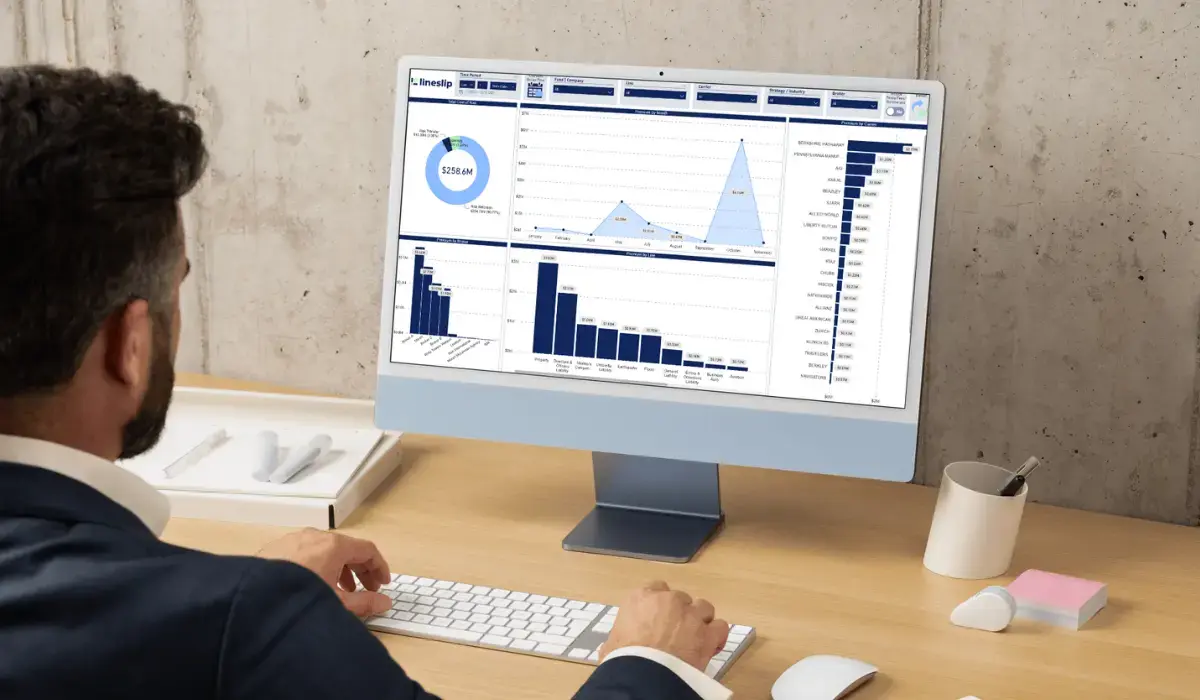

LineSlip helps corporate risk and insurance teams accelerate access to insurance policy and program information for recurring workflows such as comparison, reporting, renewal, historical analysis, program visualization, and decision support. That is the starting definition, and it is worth stating plainly before getting into anything else. LineSlip positions this work under the broader category of insurance intelligence.
Defining the boundaries around that role matters because insurance technology categories overlap in practice. A corporate risk team might use a RMIS, work with brokers and advisors, rely on internal insurance professionals, maintain document repositories, and use LineSlip, all within the same insurance program. Understanding LineSlip means understanding which of those roles it plays and which roles stay with someone else. Clear product boundaries help a buyer understand exactly what LineSlip does, rather than guessing based on adjacent categories like RMIS platforms, claims systems, or general-purpose AI tools.
What LineSlip Does
LineSlip focuses on insurance policy and program information and the recurring workflows in which corporate risk teams need to access, compare, understand, and communicate that information.
LineSlip works with commercial insurance documents, including policies, binders, endorsements, and related coverage documents. It extracts and classifies information such as carrier, entity, coverage, premium, limit, retention, and policy dates, along with other validated policy information. Extraction and classification create the foundation for the workflows that follow.
Once information is extracted and classified, LineSlip surfaces it for the workflows corporate risk teams run, including policy comparison, policy-year comparison, reporting, renewal preparation and analysis, historical review, program analysis, executive and governance reporting, and program visualization. The value comes from how that information supports these workflows.
Insurance information often becomes more useful in relation to other program information, such as how policies relate to entities, how policy years relate to each other, or how carriers, premiums, limits, retentions, layers, and attachment points relate across a program. Program Schematic, LineSlip's insurance tower visualization, is a concrete example of this capability, particularly for layered insurance programs where those relationships are otherwise hard to see all at once.
LineSlip Combines Technology With Insurance Expertise
Insurance expertise is part of the LineSlip service model.
Insurance professionals review and validate the information LineSlip extracts, pairing insurance-specific technology with insurance-professional review. That review checks the underlying information while customers and their advisors remain responsible for downstream interpretation and insurance decisions.
LineSlip's technology extracts, classifies, and surfaces relevant insurance information. Insurance professionals bring domain expertise to reviewing that information. Corporate risk and insurance professionals then apply their own organizational context and professional judgment when using that information to make decisions. Each of these is a distinct role, and none of them substitutes for the others.
LineSlip can surface information, comparisons, program relationships, historical context, and other relevant inputs. It does not determine what coverage an organization should purchase, which carrier it should select, what limits are appropriate, or what insurance decision the organization should ultimately make. LineSlip is not an autonomous decision-making system, and it supports the people who make those decisions rather than replacing them.
Who LineSlip Is Built For
LineSlip fit is driven more by insurance-program complexity and recurring information needs than by company size alone.
The primary audience includes Heads of Risk, Risk Managers, VPs of Insurance, corporate insurance teams, and other professionals responsible for complex commercial insurance programs. LineSlip's center of gravity is the corporate insured, not insurers, brokers, or underwriting organizations.
Organizations with a significant number of policies, multiple entities, multiple carriers, multiple coverage types, multiple policy years, layered program structures, recurring reporting requirements, frequent policy or program comparison, active renewal analysis, or governance and executive information requirements tend to see the strongest fit. There is no minimum revenue or employee threshold published here, deliberately. Larger organizations frequently have the scale and complexity that create these needs, but company size is only a proxy for that complexity, not the thing that determines fit. A more useful qualification question is whether the complexity of the insurance program creates a recurring need to access, compare, report on, or understand policy and program information across multiple dimensions.
Organizations with relatively straightforward insurance programs and limited recurring needs for comparison, historical analysis, reporting, or program-level visibility may simply have less need for what LineSlip provides.
What LineSlip Does Not Do
LineSlip has a deliberately focused role. It is not intended to replace the systems and professionals responsible for adjacent insurance functions.
LineSlip Is Not a RMIS and Does Not Replace a RMIS
A RMIS can serve as foundational operational infrastructure for corporate risk organizations. LineSlip focuses on insurance policy and program information and can complement and integrate with a RMIS. A company does not need to have a RMIS to use LineSlip.
LineSlip Is Not a Claims Management System
LineSlip's role centers on insurance policy and program information. Claims management remains a separate workflow covering an active claim from notice through resolution.
LineSlip Is Not an Underwriting System
LineSlip does not underwrite insurance, price risk, or make underwriting decisions. Underwriting technology supports an insurer's evaluation and pricing of risk, while LineSlip is designed primarily for corporate risk and insurance teams managing their organization's own commercial insurance program.
LineSlip Is Not a Policy Administration System
LineSlip extracts, classifies, and surfaces information from policies and related insurance documents. Issuing, servicing, and administering those policies remain separate functions.
LineSlip Does Not Replace Brokers or Advisors
LineSlip gives corporate risk teams independent visibility into their own insurance policy and program information. That visibility can help teams enter conversations with brokers and advisors with clearer historical context, program information, and questions already in hand. Better information can support better-informed collaboration with the broker.
LineSlip’s Technology Does Not Replace Insurance Professionals, but LineSlip Employs Them as Part of Its Service Model
LineSlip combines insurance-specific technology with insurance-professional review and validation. Technology accelerates access to insurance information. Insurance expertise remains integral to reviewing and using that information well. Corporate risk teams, brokers, advisors, and LineSlip's own insurance professionals all continue to apply professional judgment to insurance decisions, and none of that judgment is something the technology is meant to take over.
LineSlip Is Not General-Purpose AI
General-purpose AI is designed to work across broad domains and use cases. LineSlip uses insurance-specific technology, data models, and domain expertise focused on commercial insurance policy and program information. LineSlip's distinction is its purpose, insurance context, and domain expertise.
LineSlip Is More Than Document Extraction or Document Storage
Document storage or extraction alone does not describe LineSlip's role. Its value extends to accelerating access to insurance information and surfacing it for workflows such as comparison, historical analysis, reporting, renewal, program visualization, and governance and executive visibility. This clarifies where LineSlip's value sits within the broader insurance technology environment.
Where LineSlip Fits Within the Insurance Technology Environment
|
Function |
Primary Role |
|
Insurance policy and program information |
LineSlip |
|
Operational risk workflows and RMIS functions |
RMIS and related systems |
|
Claims management |
Claims and RMIS workflows |
|
Underwriting and risk pricing |
Insurers and underwriting systems |
|
Policy issuance and administration |
Insurers and policy administration systems |
|
Brokerage and advisory |
Brokers and advisors |
|
Insurance decisions and professional judgment |
Corporate risk and insurance professionals |
This table describes where each function primarily sits today and clarifies the role each technology or professional group plays.
How LineSlip Supports the Work Corporate Risk Teams Already Do
LineSlip's focused role lets it support recurring insurance workflows without attempting to own every adjacent insurance function.
Policy and Policy-Year Comparison
Accessible current and historical information supports policy-year comparison and gives the risk team a clearer basis for evaluating what changed.
Renewal Preparation and Analysis
Current and historical insurance information can help risk teams identify changes and prepare sharper questions before renewal discussions begin.
Reporting and Executive Visibility
Relevant insurance information can be surfaced for insurance reporting and stakeholder communication across executive and governance workflows.
Insurance Program Visualization
Program Schematic surfaces relationships among carriers, layers, premiums, limits, attachment points, and carrier participation, giving a concrete example of how program-level information becomes visible rather than staying scattered across separate documents.
Working Alongside Existing Technology and Partners
RMIS integration, brokers, internal insurance teams, and LineSlip's own insurance professionals all sit within the same insurance workflow. LineSlip strengthens access to insurance information within that broader environment.
How to Determine Whether LineSlip Fits Your Insurance Program
A few questions tend to be more useful than company size for evaluating fit:
-
Does our team work across enough policies, entities, carriers, coverage types, or policy years that comparisons routinely cross multiple sources?
-
Do we repeatedly need the same insurance information for reporting, renewal, governance, or executive questions?
-
Do we need clearer historical visibility into how our insurance program has changed?
-
Do we manage layered programs where relationships among carriers, limits, premiums, and attachment points matter?
-
Would faster access to policy and program information help our risk and insurance professionals spend more time interpreting information rather than reconstructing it?
-
Do we need insurance information to complement workflows already supported by a RMIS or other systems?
-
Would independent access to our insurance information support more informed conversations with brokers and advisors?
There is no scoring threshold here, and answering "yes" to some of these questions rather than all of them does not disqualify an organization from a good fit.
Clear Boundaries Make LineSlip Easier to Evaluate
LineSlip helps corporate risk and insurance teams accelerate access to insurance policy and program information within a deliberately focused role. It can complement a RMIS, support broker and advisor relationships, and combine technology with insurance-professional expertise. Claims management, underwriting, policy administration, and final insurance decisions remain with the systems and professionals responsible for those functions.
The result should be a clearer answer to the question that matters most to a buyer: is LineSlip designed to solve the insurance-information challenges your organization has? If you're evaluating fit for your own program, you can connect with the LineSlip team to talk through where LineSlip would sit alongside what you already have in place.
Frequently Asked Questions
1. What Does LineSlip Do?
LineSlip helps corporate risk and insurance teams accelerate access to insurance policy and program information for comparison, reporting, renewal, historical analysis, program visualization, and other insurance decision workflows. It extracts, classifies, and surfaces that information, and insurance professionals review and validate it along the way.
2. Who Is LineSlip Designed For?
LineSlip is designed for corporate risk and insurance teams managing complex commercial insurance programs, including organizations with multiple policies, entities, carriers, policy years, and recurring reporting requirements. There is no simple company-size threshold that determines fit.
3. Does LineSlip Replace a RMIS?
No. LineSlip complements and can integrate with a RMIS rather than replace one, and a RMIS is not required to use LineSlip.
4. Does LineSlip Manage Claims?
No. LineSlip focuses on insurance policy and program information rather than claims-management workflows.
5. Does LineSlip Underwrite Insurance?
No. LineSlip does not price risk or make underwriting decisions. It is designed to support corporate risk and insurance teams working with their organization's own commercial insurance information.
6. Does LineSlip Administer Insurance Policies?
No. LineSlip works with information contained in commercial insurance policies and related documents, but it is not the system responsible for issuing, servicing, or administering those policies.
7. Does LineSlip Replace Insurance Brokers or Advisors?
No. LineSlip gives corporate risk teams independent visibility into their own insurance information, which supports more informed collaboration with brokers and advisors rather than replacing them.
8. Does LineSlip’s Technology Replace Insurance Professionals?
No. LineSlip’s technology extracts, classifies, and surfaces insurance information. Insurance professionals are part of LineSlip’s service model and review and validate the extracted data. Professional insurance judgment remains essential when customers interpret that information and make decisions.
9. Is LineSlip a General-Purpose AI Tool?
No. LineSlip uses insurance-specific technology, data models, and insurance expertise focused on complex commercial insurance programs, rather than functioning as a broad, general-purpose AI tool.